Pesto Potato Salad Recipe
Potato salad doesn’t always need a mountain of mayo to be really good. This pesto potato salad swaps out heavy mayo for herby, bright pesto that coats the potatoes in a lighter, super flavorful dressing.
Honestly, I started making this because I wanted a potato salad that felt less heavy but still packed with flavor. Turns out, it’s become one of my go-to sides.
You can pull this together in about 30 minutes, give or take. The ingredients are simple, and you probably have most of the kitchen tools already.
Pesto gives this salad a fresh spin that’s a little unexpected at picnics or weeknight dinners. It just stands out in a good way.
Let’s talk about what you’ll need, the ingredients, how I throw it together, and maybe what to expect when you dig in.
Equipment
Nothing fancy here—just basic stuff you probably already have.
You’ll want a large pot for boiling potatoes, a cutting board, and a sharp knife for chopping. Don’t forget a colander or strainer to drain them.
Grab a large mixing bowl and a wooden spoon or spatula for tossing everything together. Measuring cups and spoons help keep things on track.
A small bowl is handy for mixing up the pesto dressing. Your pot should be big enough to let the potatoes float around—at least 4 quarts is good.
The mixing bowl needs to be roomy so you’re not chasing potatoes all over the counter. I’d say at least 3 quarts.
A sharp knife makes life easier when you’re cutting cooked potatoes. Dull ones just slip and make a mess.
The colander? You’ll want one that can handle hot potatoes without warping. Trust me.
If you’re a stickler for timing, a kitchen timer is nice, but honestly, I just use my phone.
Making pesto from scratch? You’ll need a food processor or a blender. But if you’re not in the mood, store-bought pesto is totally fine.
Ingredients
I keep this pretty simple so you can tweak it to your taste. The main ingredients work together for a salad that’s fresh and honestly, a little addictive.
For the salad itself, you’ll want about 2 pounds of potatoes. I lean toward baby potatoes or new potatoes—they hold up after cooking and don’t get mushy.
Yukon Gold, red potatoes, or fingerlings are also solid choices. Waxy potatoes are your friend here. I’d skip russets—they just fall apart.
For the pesto dressing, here’s what I use:
- 1/2 cup basil pesto (store-bought or homemade, whatever works)
- 1/4 cup olive oil
- 2 tablespoons lemon juice
- 1 teaspoon lemon zest
- Black pepper, to taste
If you want to make your own pesto, you’ll need:
- 2 cups fresh basil leaves
- 1/3 cup pine nuts (toasted if you want extra flavor)
- 1/2 cup Parmesan cheese
- 3 cloves garlic
- 1/2 cup olive oil
Sometimes I’ll stir in a little Greek yogurt—about 1/4 cup—just to make it creamier without loading up on oil.
Going vegan? Use vegan pesto and swap the Parmesan for vegan parm or nutritional yeast. Sliced almonds work if you’re out of pine nuts.
I like to finish mine with extra basil or Italian parsley. Some folks add a splash of red wine vinegar for a little kick.
Instructions
First things first, I preheat my oven to 400°F. While that’s happening, I chop the potatoes into bite-sized pieces, roughly an inch each.
I toss them with olive oil, salt, and pepper, spread them out on a baking sheet, and roast for 25-30 minutes. I flip them halfway so they brown up evenly.
While the potatoes roast, I throw together the pesto. Into the food processor goes fresh basil, garlic, pine nuts, Parmesan, olive oil, salt, and pepper.
I blend until it’s smooth, and if it’s too thick, a splash more olive oil does the trick.
Once the potatoes are golden and cooked through, I let them cool about 10 minutes. Then it’s into a big bowl with them.
I pour the pesto over and toss gently so every potato gets a nice coating. The warmth helps the flavors soak in.
That’s really all there is to it. I taste and adjust salt or pepper if needed. You can serve it warm or chill it for half an hour if you like it cold. Both ways are pretty great.
Notes
The best potatoes for this salad are the ones that hold their shape—Yukon Gold or reds are my usual picks. Russets are just too crumbly.
If you’re making pesto from scratch, it’s just basil, pine nuts, garlic, Parmesan, and olive oil in a food processor. Store-bought is fine if you’re in a rush.
You can make the salad a day ahead—the flavors actually get better after sitting in the fridge. Just add fresh herbs right before serving so they stay bright.
If pine nuts are too pricey, swap them for walnuts or almonds. They work just as well and are easier on the wallet.
Don’t overcook your potatoes or they’ll fall apart when you mix everything. I poke them with a fork after about 15 minutes—they should be tender but not mushy.
I think it tastes best at room temp, so I let it sit out for 30 minutes before serving.
Extra Parmesan on top? Yes, please. Sometimes I drizzle a little more olive oil before serving, too.
Leftovers keep well in a sealed container in the fridge for up to three days.

Equipment
- Oven
- Baking sheet
- Parchment paper (optional)
- Large mixing bowl
- Small bowl (for dressing)
- cutting board
- sharp knife
- Measuring cups and spoons
- Spatula or wooden spoon
Ingredients
- 2 pounds baby potatoes Yukon Gold, red potatoes, or fingerlings; cut into 1-inch pieces
- 1 1/2 tablespoons olive oil for roasting potatoes
- 1 teaspoon salt divided, or to taste
- 1/2 teaspoon black pepper plus more to taste
- 1/2 cup basil pesto store-bought or homemade
- 1/4 cup olive oil for thinning pesto dressing
- 2 tablespoons lemon juice freshly squeezed
- 1 teaspoon lemon zest
- 1/4 cup Greek yogurt optional, for a creamier dressing
- 2 tablespoons fresh basil or Italian parsley optional, chopped for finishing
- 2 tablespoons Parmesan cheese optional, grated for serving
Instructions
- Preheat the oven to 400°F (200°C). Line a baking sheet with parchment if desired.
- Cut the potatoes into 1-inch bite-sized pieces. Toss with 1 1/2 tablespoons olive oil, 1/2 teaspoon salt, and 1/2 teaspoon black pepper. Spread in an even layer on the baking sheet.
- Roast for 25–30 minutes, flipping halfway, until golden and fork-tender.
- While the potatoes roast, whisk together pesto, 1/4 cup olive oil, lemon juice, and lemon zest in a small bowl. If using Greek yogurt, whisk it in for a creamier dressing. Season with a pinch of salt if needed.
- Let the roasted potatoes cool for about 10 minutes (they should still be warm but not steaming).
- Transfer potatoes to a large bowl. Pour the pesto dressing over and toss gently until evenly coated.
- Taste and adjust seasoning with the remaining salt and extra pepper as needed. Sprinkle with chopped herbs and Parmesan (optional).
- Serve warm, at room temperature, or chilled. If chilling, refrigerate at least 30 minutes for flavors to meld.
Notes
Nutrition
Tasting Notes
When I first tried this pesto potato salad, I was honestly surprised by how much it stands apart from the old-school version. The basil pesto gives it this fresh, herby kick that just flips your expectations upside down.
The potatoes stay creamy inside, but they’ve got a little bite on the outside, which I really like. Every forkful hits you with garlic and parmesan from the pesto—it’s bold, but not too much.
Pine nuts? They bring in this unexpected crunch that plays off the soft potatoes. I didn’t think I’d care about that, but it actually makes a difference.
You can serve this warm or cold, and honestly, both ways work. Warm, the pesto flavor pops even more, and the cheese sort of melts into everything. Cold, it’s got a refreshing vibe and the flavors mellow out together.
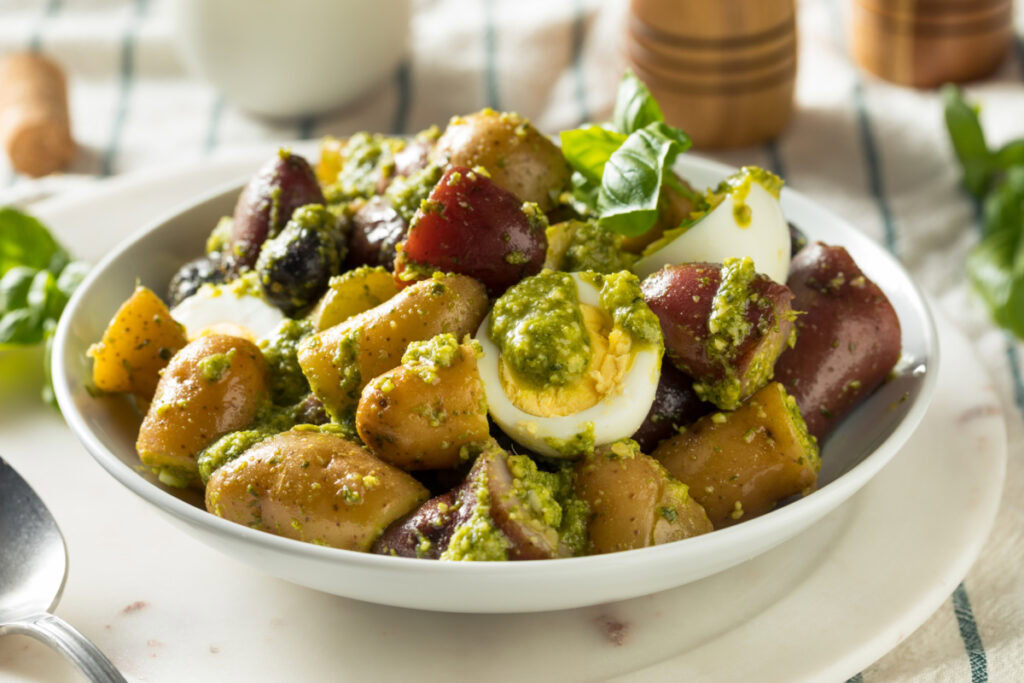
The green color from the pesto is pretty striking—it doesn’t look like your usual potato salad at all. Instead of that heavy mayo thing, you get these bright, garlicky notes with every bite.
The cheese brings in a salty, savory punch that keeps you coming back for more. Texture-wise, it’s nothing like those mushy potato salads—this one has some real structure.
The pesto coats the potatoes without making the whole thing feel greasy or weighed down, which is always a plus. If you’re into basil and garlic, this might be your new go-to.
It’s lighter than the mayo-heavy versions, but still totally satisfying. The flavors are big, but they don’t knock you over.